
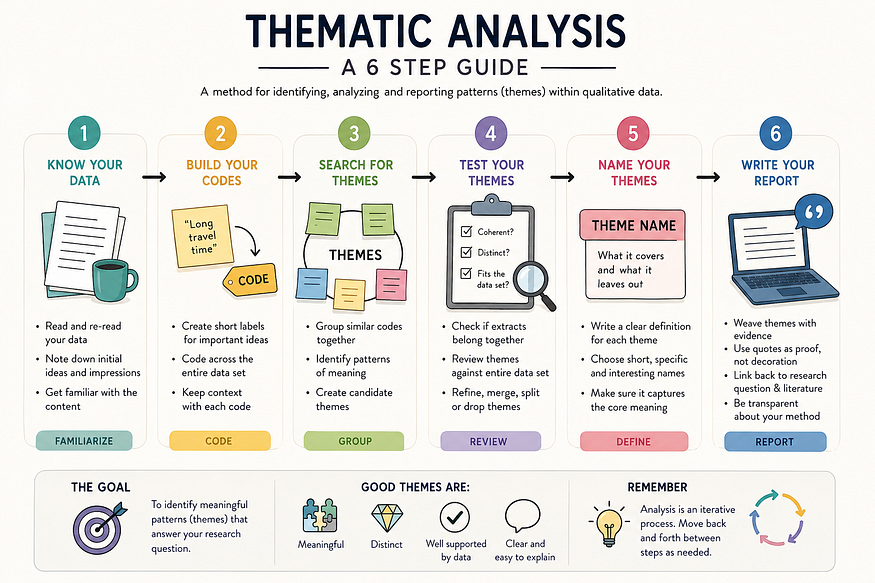
Thematic analysis is one of the easiest ways to make sense of qualitative data. If you have interview transcripts, open ended survey replies, focus group notes or social media comments sitting in a folder, thematic analysis helps you find the patterns hiding inside them. This guide explains the popular Braun and Clarke framework in plain words, step by step.
What Thematic Analysis Means
Thematic analysis is a method of reading qualitative data closely and grouping similar ideas into themes. A theme is not simply a topic that shows up many times. A theme is a pattern of meaning that says something useful about your research question. Counting words is not analysis. Explaining what those words mean is.
Why Researchers Prefer It
It is flexible, so it works in media studies, education, health, marketing and social science alike. It doesn’t need expensive software. It suits both small student projects and large funded studies. Most importantly, it is a good first method for anyone new to qualitative research, because the logic is easy to follow and easy to defend in a viva or a peer review.
The Braun and Clarke Framework
In 2006, psychologists Virginia Braun and Victoria Clarke published a six-phase guide to thematic analysis that has since become the most cited reference in the field. Braun is based at the University of Auckland and Clarke at UWE Bristol. Their six steps are not a straight line. You will move back and forth between them and that is normal.
Step 1: Know Your Data
Read everything, then read it again. If you can, transcribe the interviews yourself, because typing slows you down and forces you to notice detail. Keep a notebook for first impressions, surprises and questions. Do not start labelling yet. This step is about becoming familiar, not about being fast.
Step 2: Build Your Codes
A code is a short label attached to a piece of data. It can be plain, such as “long travel time” or interpretive, such as “feeling left out”. Work through the entire data set, not only the parts you find interesting. Always keep enough surrounding text so the meaning is not lost later. Highlighters and a simple Excel sheet work fine. NVivo, ATLAS.ti or Taguette help when the data set is large.
Step 3: Search for Themes
Now sort your codes into groups. Codes that point to the same idea can be pulled together into a candidate theme. Sticky notes or a mind map makes easier to work with. Some codes will become sub themes. Others will not fit anywhere yet, so park them in a spare pile rather than forcing them in.
Step 4: Test Your Themes
Every candidate theme needs two checks. First, do the extract inside it truly belong together? Second, do all the themes together give a fair picture of the whole data set? Be ready to merge two weak themes, split one crowded theme or drop a theme that looked exciting but has thin evidence behind it. This step separates careful research from guesswork.
Step 5: Name Your Themes
Write a two- or three-line definition for each theme, explaining what it covers and what it leaves out. Then give it a name that is short, clear and interesting to read. If you cannot explain a theme in one sentence, it is not ready. Avoid vague labels such as “issues” or “challenges”, because they tell your reader nothing.
Step 6: Write Your Report
Good writing weaves argument and evidence together. Use quotes as proof, not decoration and keep them short. Link each theme back to your research question and to existing literature. Describe your method honestly, including how many participants you had and how codes were checked, so readers can judge how far to trust your findings.
Mistakes to Avoid
Four errors appear again and again in student work:
- Turning interview questions into themes
- Reporting how often something was said instead of what it meant
- Selecting only the quotes that support your expectation
- Skipping the review step because deadlines are close
Final Thoughts
Thematic analysis rewards patience more than technique. Give yourself time to sit with the data, question your own early ideas and write down every decision you make. Do that and your themes will feel earned rather than assumed, this is exactly what examiners and reviewers look for.
Author: Anushka Kulkarni